---- News, Views & Information
|
Amersham ---- News, Views & Information |
I am grateful to Frank Phillipson for providing the following article
History
Amersham and District Motor Bus and Haulage Co. Ltd. was set up on the
15th September 1919 by a local doctor and some friends to serve the
surrounding area. Initially it had three vehicles and started operating
from the yard of The Griffin before opening a garage in The Broadway, Old
Amersham.
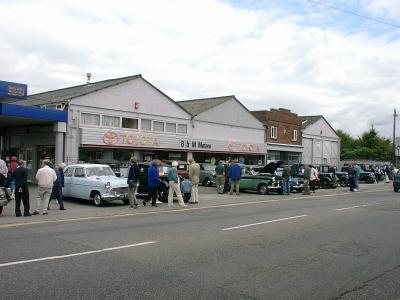
Now Car Garages, this is the original bus garage in
Amersham
Its first route was from Chesham to High Wycombe running via Amersham
(route 1 evolving into LT route 362) and used two buses. In 1922 it
started a route from Chesham via Amersham to Slough and designated it
route 3 a forerunner of LT route 353. The Company's symbol at this time
was 'Pride of Bucks.'
In 1923 the Slough route was extended to Windsor. 1924 saw the
introduction of routes to Beaconsfield, Holmer Green and Chalfont St.
Giles.
In December 1932. The Amersham and District (A&D) took over the routes
of the Chesham and District Bus Company to Berkhampstead, Tring and Hemel
Hempstead.
The London General Omnibus Company (LGOC), which dominated the central
London area, bought a financial stake in the Amersham and District in
August 1929. At this date the A&D had thirty vehicles.
Amersham and District had a High Wycombe garage opened in 1929 which in
June 1930 was in charge of LGOC services from High Wycombe to Uxbridge, a
route which competed with the Skylark Motor Coach Company.
In August 1920, the National Omnibus and Transport Co. Ltd. started their
'N6' route to Chesham via Rickmansworth operated from their garage in
Watford. This route was the forerunner to LT's route 336.
From early 1920, Thames Valley Buses operated a service from High Wycombe
to Amersham and Great Missenden until 1928.
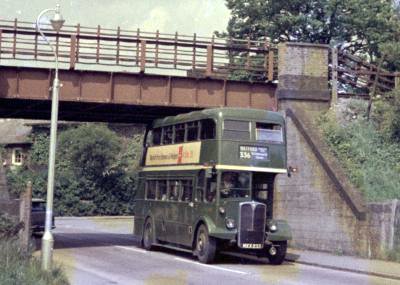
Picture Courtesy of Nick Vince.
RLH33 going under Black Horse Bridge circa mid 1960s on route 336
(Note, pictures of some local buses from 1952 can be seen here)
Thames Valley had an agreement with the LGOC to run and develop services
on their behalf from the newly opened (1922) LGOC garage in Uxbridge. A
Great Missenden via Amersham service (route W23) was in operation by the
summer of 1922. The route was cut back to Amersham by January 1923. The
service ran until December 1928 when the agreement with the LGOC expired.
They took back the service and had the A&D run it. It became an
express coach service run by the A&D as Service 17 Amersham to Oxford
Circus in January 1931. This later became a Green Line route (route 'R'
(via Uxbridge?)). Another reference suggests that bus route W23 became LT
route 504.
Frederick Lewis started a bus service in 1923 from Watford to
Rickmansworth. Lewis took over North West Land Transport buses to form
Lewis Omnibus Co. Ltd. This firm in 1930 started running a service to
Berkhamsted via Amersham which was almost the same as the Nationals N6
Route. Lewis Omnibus Co. Ltd. was taken over by the LPTB on the 1st
October 1933.
The Rover Bus Service (J.R.Dell) for a long period ran a service between
Hemel Hempstead and Chesham which it shared at one time with LT. The route
was from Chesham to Hemel Hempstead via Bovingdon and Lye Green and was
allocated the route number 316. LT found that it was unremunerative and
pulled out of the joint operation altogether from 6th May 1964. At the
same time this route number was being used for a Sunday service from
Amersham to Ley Hill!
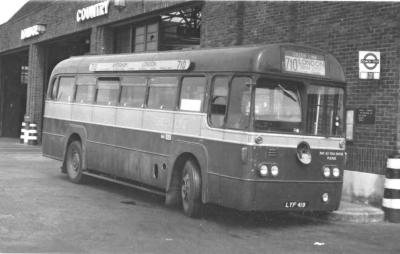
Green Line RF Service 710 outside Amersham Bus Garage
With regards to limited stop express coach services from or through
Chesham or Amersham into London there were a number of operators.
West London Coaches started a service in May 1928 from central London to
Aylesbury via Rickmansworth and Amersham. In October 1929 they introduced
a service to Chesham. In June 1931 Chesham became served from the Amersham
- Aylesbury route by a shuttle bus to / from Amersham (Sycamore Corner)
where it met the coaches on the main route. West London Coaches continued
their service until acquired by the LPTB in January 1934. The service
became Green Line route B from London via Rickmansworth and Amersham to
Chesham and Aylesbury alternately.
The Premier Omnibus Company were bus operators from Shepherds Bush. They
entered the coach operation field in January 1930 and set up a separate
company in October 1930 called Premier Line Ltd. In summer 1931 they
commenced a service from Aylesbury to Slough and Eton via Amersham (route
F) which although worked by coaches ran as a bus service with frequent
stops and bus fares. The Local Traffic Commissioners felt that this
service duplicated the A&D service. Agreement between the two
companies led to Premier operating two hourly from Aylesbury to Slough and
A&D two hourly from Great Missenden to Windsor (route 19) with a
co-ordinated timetable. Premier Line was acquired by the LPTB in December
1933 and route F became country bus route 19, later route 369. In May 1936
route 369 was withdrawn in favour of a revised route 353 from Windsor to
Berkhamsted.
The LGOC started limited stop coach services in other areas into London in
1929 and formally set up Green Line Coaches Ltd., in July 1930.
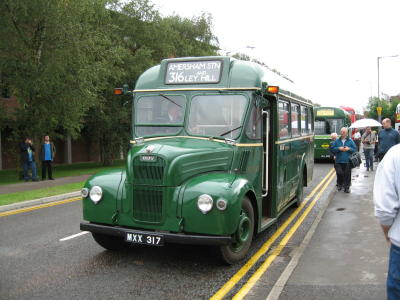
GS Type Bus at the Amersham Bus Rally 2006
Green Line had an application to run services from Chesham and Amersham to
London via Rickmansworth in November 1930 turned down by the local
councils. A&D, with the financial interest of the LGOC, successfully
applied for a licence for the service and the LGOC transferred five
coaches to the A&D to run the service. They ran an hourly service from
Chesham to London via Amersham and Gerrards Cross with it first starting
from Amersham (Oakfield Corner) in January 1931 and from Chesham in
February the same year.
In February 1931 the Southern Area Traffic Commissioner reviewed the
A&D service and made them start and finish the route from Amersham
garage. He believed that West London Coaches service already served that
town's needs. The A&D service was continued until October 1933 when it
was taken over as Green Line route R.
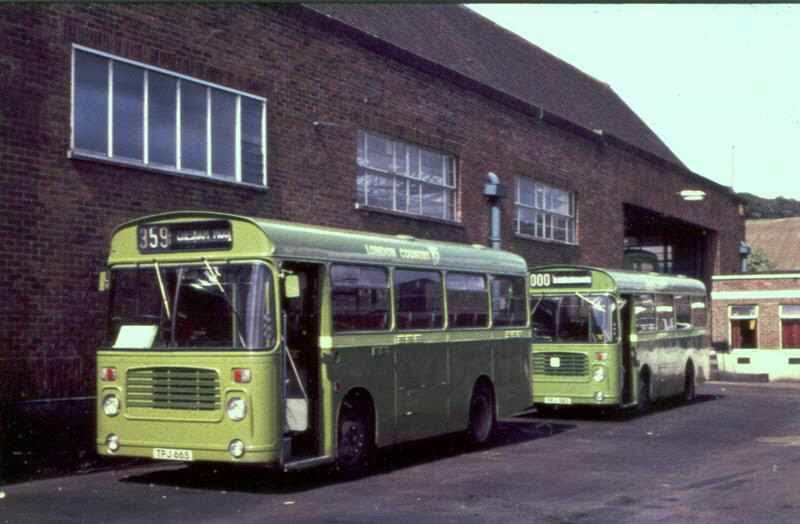
Service 359 at the side of Amersham Bus Garage mid
1980s
At this period the LGOC had services in the country areas run on its
behalf by companies it owned, or had an interest in or agreements with. In
January 1932 it formed the London General Country Services Ltd., (LGCS)
which took over most of these companies or routes. Initially their buses
had the LGOC red livery but with the fleet name "General Country
Services". In May 1933 LGCS buses first appeared in green livery.
In April 1932 Green Line Coaches were transferred from the LGOC to the
LGCS. It was at about this time that Green Line Coaches were painted in
two-tone green livery. A year later Green Line services were all organised
into a lettered route system.
The London Passenger Transport Board (LPTB) was created under the London
Transport Act of 1933. Its purpose was to create a more efficient public
transport system with less duplication and more standardisation under one
body.
On the 1st July 1933 the LPTB took over all bus, tram, trolley-bus and
underground railways in London (including the Metropolitan serving
Amersham) and the surrounding Outer London areas. It was a publicly
controlled organisation but had to be self financing. The LGCS and Green
Line Coaches, as well as some independent operators, were taken over in
the London Country area on this date by LPTB's Country Bus and Coach
Department. Some other independent operators were taken over in the
following months. From 1934 the 'London Transport' fleet-name began to be
used.
On the 24th November 1933 Amersham and District was bought by the LPTB
although the company name was still to be seen on their garage in 1934. At
the date of take over A&D had 48 vehicles and its well planned
services lasted until 1936 before being altered significantly.
LPTB opened a new garage in Amersham in 1934 which was adjacent to the
former A&D garage. The LPTB introduced codes for each garage and
Amersham was designated MA (AM having already been allocated to Plumstead
(the reason why Plumstead has code AM is described here
)) and High Wycombe was allocated HE. The garage was closed in
April 1992 and then demolished for a Tesco petrol station.
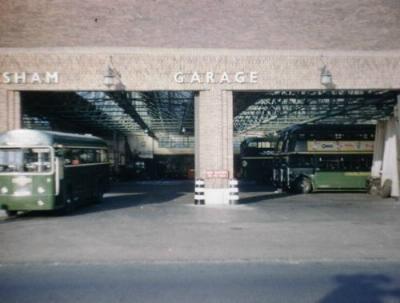
Amersham Bus Garage in about 1960.
Now demolished and replaced by a super market (Tesco) and petrol
station
In July 1934 Amersham was served by terminating Green Line route Q (which
also ran alternatively to High Wycombe), terminating route R and by route
B which terminated in Aylesbury. Route B also ran alternatively to
Chesham. Route B ran to London and Kent via Rickmansworth and Wembley
while routes Q and R ran via Gerrards Cross and Uxbridge to London.
In December 1924 the London Traffic Act directed that all country bus
routes entering the London Metropolitan Police area be designated in the
300 and 500 series north of the Thames and 400 series south of the Thames.
This system was called the 'Bassom' scheme after the acting chief
constable of the Met. Police. The LPTB seems to have extended the
numbering series to country routes wholly outside the area so as to have a
single system of route numbering. The 500 series routes were eventually
renumbered in the 400 series.
On the 3rd October 1934 the LTPB allocated the following route numbers in
the Amersham area:-
A&D route 3 (Windsor-Gerrards Cross-Amersham-Chesham-Ley Hill) became
route 353.
A&D route 19 and Premier Line service (Windsor-Amersham-Aylesbury)
became route 369.
A&D routes 1&2 (High Wycombe-Amersham-Chesham (The Sportsman) OR
Ley Hill) became route 362
Re-organisation in the Amersham area was introduced on the 13th May 1936.
Routes 369 and 369A, Aylesbury to Slough and Great Missenden to Chesham
via Amersham respectively were both discontinued. A modified Green Line
route B service was substituted with bus fares on the Great Missenden -
Amersham section with the route diverging into Little Missenden to cover
the former bus route.
The 13th May re-organisation also saw the extension of route 353 to
Berkhamsted.
The reorganisation saw Green Line service route L (from Bookham in Surrey)
extended on summer weekends from Uxbridge to Chesham as Route L1 during
1936 only.
In the summer of 1937 Route L was discontinued altogether with an increase
in services on routes Q & R from central London to High Wycombe and
Amersham respectively.
On the outbreak of the Second World War the all single decker Green Line
coach services were discontinued when all the vehicles were converted to
ambulances for anticipated casualties.
Bus route 393 was introduced on the lst September 1939, to replace part of
suspended Green Line route B, from Amersham (Oakfield Corner) to Great
Missenden. In January 1940 a limited route R Green Line service was
reintroduced from Chesham and Amersham Garage to Oxford Circus.
The casualty situation did not materialise and coach services were
reintroduced on some routes in 1939 and 1940 with a full service in
December 1940. This was to help counteract disruption to the railways. The
routes were all given numbers up to No.59A and all terminated in central
London.
Chesham was served by Route 34 via Gerrards Cross and Amersham and
Aylesbury by Route 35 via Rickmansworth. Green Line services were totally
withdrawn in September 1942 when rubber and fuel shortages became acute.
They were not resumed until February 1946.
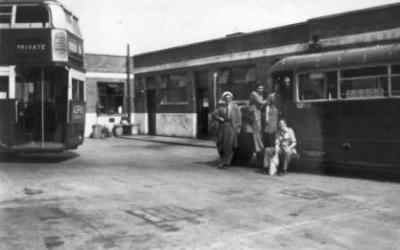
Picture Courtesy of Frank Phillipson
A view of the staff area of the Amersham bus garage
The withdrawal of Green Line route 35 saw the introduction of an Amersham
- Aylesbury service designated route 359 which was worked jointly by LT
and Eastern National (later United Counties). The joint working ceased in
1964 and LT worked the service until 1972.
When resumed in 1946 the Green Line routes were numbered in the 700
series, with yellow route blinds and black lettering. Aylesbury lost its
Green Line service via Amersham, with Amersham itself being served by
route 703 via Rickmansworth and London to Kent. Chesham was served by
route 725 via Gerrards Cross and Uxbridge to London.
In November 1947 the Green Line routes were revised with route 725 deleted
and the following routes added:-
709 Chesham to Caterham via Gerrards Cross, Uxbridge and Oxford Circus
710 Amersham Garage to Crawley via Gerrards Cross, Uxbridge and Oxford
Circus.
In October 1954 route 710 was withdrawn for three weeks due to staff
shortage. In 1956 route 709 lost its Amersham to Chesham section outside
peak hours and weekend mornings.
From 4th November 1964 the whole of route 703 which now ran to Chesham was
withdrawn because of loss of traffic after the Metropolitan Line
electrification. In an attempt to speed up and attract traffic route 709
to Chesham was re routed between Shepherds Bush and Uxbridge via Western
Avenue and had reduced stops and didn't run on Sundays, Chesham being
served on that day by an extension of route 710 from Amersham. However,
this failed and from 1st November 1965 route 709's northern section from
London was totally withdrawn with route 710 extended to Chesham on all
days.
On the 31st December 1966 new schedules were introduced because of the new
five day working week. On this date route 710 was cut back from Chesham to
Amersham on Mondays to Fridays and lost some additional peak hour "short"
workings from Amersham to London.
On November 1968 route 710 now Chesham - Amersham - Gerrards Cross -
London - Crawley, was altered to run from Amersham Garage to Baker Street
only and was converted to 'One Man Operation' (OMO). In October 1972 this
remaining section of route 710 now running to Amersham via Uxbridge was
deemed to be uneconomic and was withdrawn.
On 10th July 1966 a new London peripheral route was introduced from High
Wycombe to Romford. This service was numbered route 724 and ran via
Amersham - Rickmansworth - Watford - St Albans - Hatfield - Welwyn Garden
City - Hertford - Ware - Harlow and Epping. It was the first Green Line
route to be One Man Operated and in a modified form was still operated in
1998
The Transport Bill of 1947 saw the LPTB dissolved and on the 1st January
1948 the nationalised London Transport Executive (LTE) took over. They
were responsible to the British Transport Commission (BTC) who oversaw all
forms of nationalised transport.
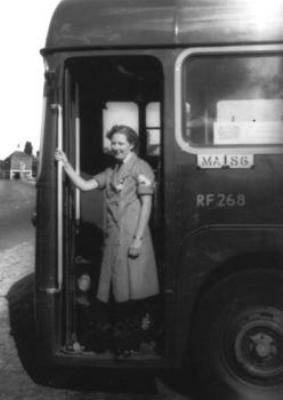
Picture Courtesy of Frank Phillipson.
Frank's great Aunt Mary "Moll" Grove worked as a conductress from
Amersham garage from WW2
until the late 60's. Frank recalls she mainly worked on the Greenline
coach services.
From the beginning of 1963 the London Transport Board (LTB) took over
London Transport from the LTE. The LTB was more decentralised and free to
operate as a specialised undertaking only answerable to the Minister of
Transport.
The peak of LT Country Bus services occurred in the mid 1950's after which
there was a steady decline due to car ownership, television with loss of
traditional evening and weekend traffic. Low staff morale at the falling
passenger numbers led to staff shortages which affected service
reliability. To try to counter this trend and run a reliable economic
service "One Man Operation" (OMO) was increased. The small GS type single
deck bus had operated in this form from its introduction and the RF single
deck bus were converted during this period.
Towards the end of the 1960's new buses (at Amersham single deck
Swifts(SM) and Merlins(MB) ) started to appear but they were generally
unreliable and classic 50's buses soldiered on into the 1970's.
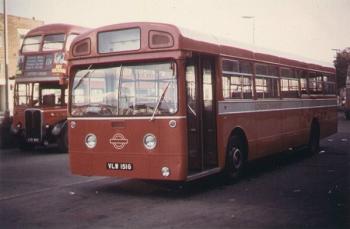
Picture Courtesy of John King
MB Merlin in central London Red livery, this type of bus (and the
similar SM Swift), with an additional
set of central doors was based at Amersham in the green and yellow
London Country livery
In 1970 control of London Transport was handed over to the Greater London
Council who had no interest in managing the Country Area buses and Green
Line Coaches. These were therefore formed into London Country Bus Services
Ltd.
Crew operations finished at Amersham on the 15th February 1971 when eight
conductors were displaced. Routes 353 and 362 were taken over from the RT
double deck buses by SM type Swift single deck buses. The rural routes
from Amersham, at this date, were all operated by RF type single deck
buses.
Bus Types
RT Type Double Decker
Initially designed and produced in limited numbers in 1939, production
resumed with some modifications in 1947. The large majority of these RT
buses (including most of those in the Amersham area) had an AEC Regent III
chassis with an AEC 6 cylinder, 9.6 litre, 125bhp diesel engine. The 56
seat bodies of this group were constructed by the Park Royal and Weymann
companies.
The origin of the "RT" designation of this type was not known by the
author. But Anthony Spencer suggests "RT
is an abbreviation of the chassis type: Regent Three",
although there is much debate over the meaning of RT and Anthony
suggests viewing This
Page for some more details. By the 1950's the RT had become
the standard double decker bus for the whole of London Transport's Central
and Country areas. Production of this version of the RT type ceased in
1954 with nearly 5,000 of them constructed.
Some RT's were allocated to Green Line Coaches and these appeared with the
Green Line fleet name, no advertising posters, a Green Line bullseye motif
centrally between upper and lower deck windows, a pale green line above
the lower windows (instead of the cream of the country bus version) and
deeper seat cushions. At times Green Line RT's stood in for country bus
RT's and vice versa.
The RT type bus lasted in LT service until 1979 when the last was
withdrawn from public service.
The RT's successor was to be the Routemaster (RM) which was designed as a
chassisless 64 seater initially with bodywork by Park Royal and an AEC or
Leyland engine. A longer version with 72 seats (RML) and a coach version
(RMC) were produced. Mass production of RM's started in 1959 but were not
seen in Country Bus and Greenline service until 1962. As far as I can
recall I don't remember seeing RM's in the Amersham area in the 1960's. No
RM's were ever allocated to Amersham garage.
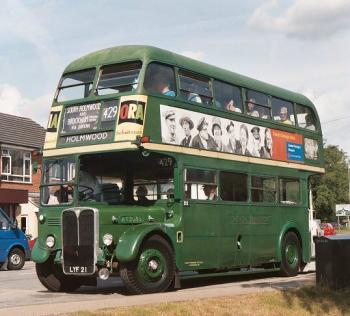
RT 2083 - Courtesy of Ian Smith
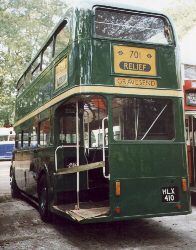
Rear View of an RT 593 - Courtesy of Ian Smith
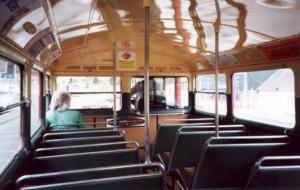
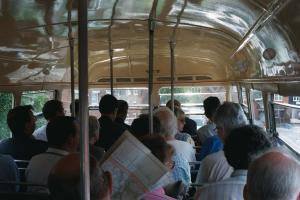
Interior views if RT - left lower deck, right upper
deck - courtesy Ian Smith
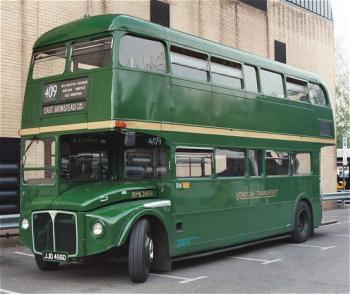
Successor to the RT - the Routemaster (RML) - Courtesy
of Ian Smith
RLH Type Low-bridge Double Decker Bus
RLH stands for "Regent Low Height" bus. It was originally designed and
built for "Midland General". Of the contract for 30 buses 'Midland' only
required 10 buses and in 1950 the rest were diverted by the government to
LT who urgently needed them to replace its existing elderly low-bridge
double deckers. LT ordered a further 56 RLHs which were very slightly
different to the initial batch.
The RLH had a RT chassis but with a 53 seat provincial bus style Weymann
body (13ft 4ins high) which had a sunken upper gangway on the offside of
the bus with 4 seater bench seats stretching across to the nearside
windows. This arrangement made it difficult for conductors collecting
fares from the passengers furthest from the gangway. Passengers on the
lower deck offside seats had to mind their heads as the sunken gangway
projected downwards from the main ceiling of the lower saloon.
Whilst RT, RF and GS type buses were built to a recognisable LT design
standard i.e. straight topped seats and in the RT a straight window across
the width of the interior saloon behind the driver the, RLH had provincial
style curved topped seats and a curve to the window across the width of
the saloon behind the driver.
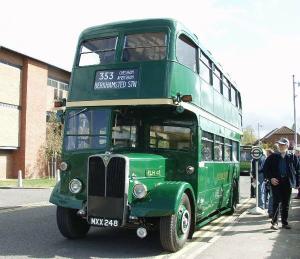
Amersham required low-bridge double deckers for route 336 which had to
negotiate Black Horse Bridge (13ft 6ins) at Amersham Common. All of the
first 20 RLH's were painted green and the first six were allocated to
Amersham in June 1950. On occasion they were used on other routes. After
1965 the Amersham RLH's were replaced on route 336 by RF single
deckers. The last RLH to run in LT public service was in April 1971.
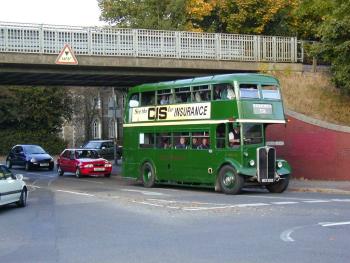
Picture Courtesy of Ewen Pring
RLH 32 going under Black Horse Bridge in Amersham
Picture Courtesy of Malcom Crowe
RLH 48
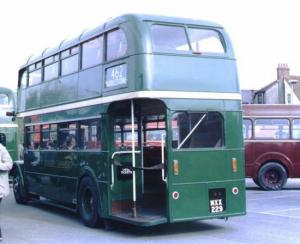
Picture Courtesy of Ewen Pring
RLH 29
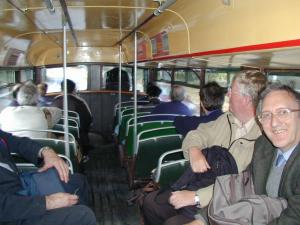
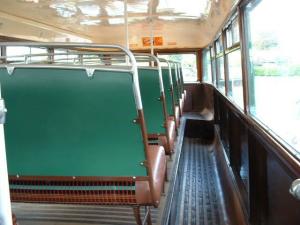
Interior views of RLH.
Left lower deck courtesy of Ewen Pring. The right hand side of the
deck has a low ceiling caused by the lower gangway on the upper deck.
Right upper deck courtesy of John King. The lower gang way and 4
across seat together with low ceiling give the impression of being
very claustrophobic
GS Type Single Deck Bus
In 1951 a new single deck bus was introduced which had a normal control
layout (a normal bonnet ahead of the driver) for LT. It had a Guy Motors
Ltd. chassis (Guy Vixen) with a Perkins P6, 65bhp diesel engine and a 26
seat body by Eastern Coach Works. The combination was known as the Guy
Special (GS).
From the outset they were designed for One Man Operation on narrow or
sparsely trafficked country routes. It had electrically operated folding
front doors and the bonnet design was the same as the Fordson Thames
lorry. On the front of the bonnet was the distinctive Guy Red Indian
Chiefs Head bonnet mascot.
The last GS in LT service operated finally in March 1972.
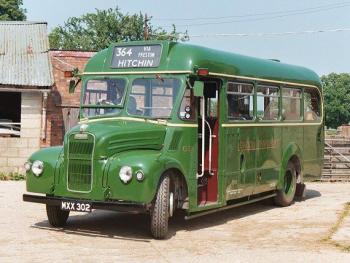
Courtesy of Ian Smith GS type bus
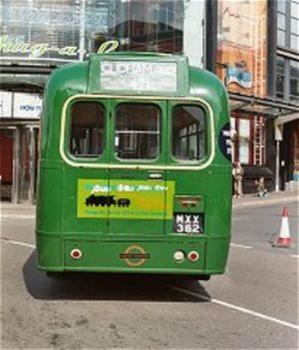
Courtesy of Ian Smith rear view of GS type bus
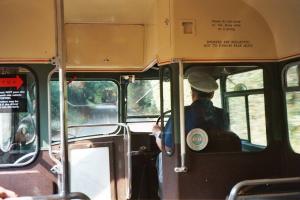
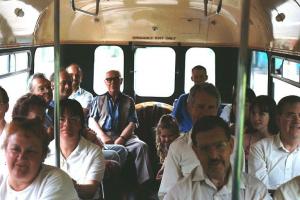
Courtesy of Ian Smith interior views of GS type bus
RF Type Single Deck Bus
In 1951 LT's standard single deck bus the RF appeared. It had an AEC Regal
IV (Regal Four = RF) chassis with an AEC 6 cylinder, 9.6 litre, 125 diesel
engine mounted horizontally beneath the floor. The body was by
Metropolitan-Cammell with a 39 seat Green Line version with folding air
doors, luggage racks and heater or the 41 seat with folding air door
country bus version.
263 were built as Green Line coaches, 185 as Country buses and 225 as
Central (Red) buses.
From 1956 to 1959 country bus RF's were converted to OMO operation with a
reduction to 39 seats. They supplanted the GS type in many areas.
Beginning in 1965 Green Line RF's were modernised with twin head lamps,
other front and rear modifications, lighter interior colours, fluorescent
lighting and a revised two tone livery with a wide light green band
beneath the windows. In 1968 country bus RF's started to be modernised
with a wide yellow band beneath the windows. In later years Green Line
RF's were demoted to country bus operations.
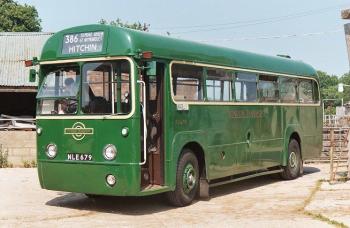
Courtesy of Ian Smith RF type bus
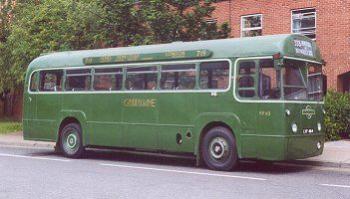
Courtesy of Ian Smith Green Line RF
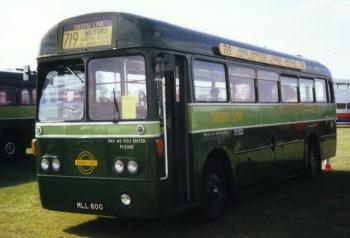
Courtesy of Ian Smith Green Line RF in late 1960s
livery
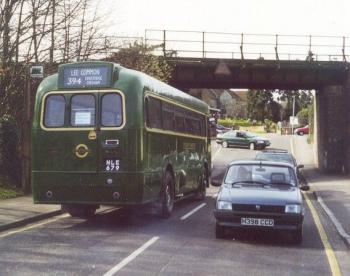
Courtesy of Ian Smith RF
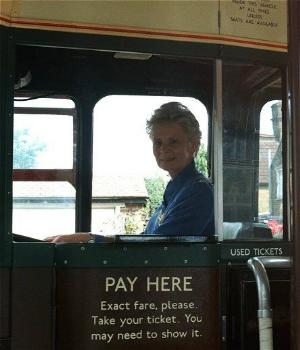
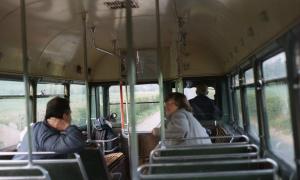
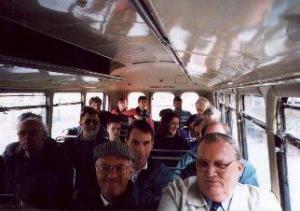
Interior views of RF courtesy of Ian Smith (right side
picture is interior of a Green Line version of the RF, it has luggage
racks and no vertical poles from the end of the seats
Heaters
From 1962 heaters were fitted to the passenger saloons of many country
area RT,RLH, RF and GS buses. The Green Line RT's had been equipped with
them in 1959. The Routemaster had heaters fitted as standard.
Tickets
Before 1953 the standard LT bus ticket was the Bell Punch type where the
conductor would have a rack of tickets and a Bell Punch cancelling machine
strapped to their uniform.
The Gibson ticket machine was introduced in 1953 and named after George
Gibson a former superintendent of LT's ticket machine works. Different
denomination tickets could be printed onto a plain paper roll by adjusting
the wheels on the side of the machine and then winding the handle on the
left-hand side to issue it. A meter recorded the number and type of
tickets issued.
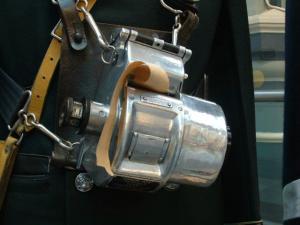
Gibson Ticket Machine courtesy of John King
Conductors on Green Line coaches from the 1950's used a 'Setright' machine
which also involved a ticket roll. On driver only operations LT introduced
the 'Ultimate' ticket machine which could issue six different denomination
pre-printed tickets.
In 1967 the 'Almex' ticket machine was introduced for use by drivers or
conductors. The tickets were smaller and had a larger fare range and
therefore could produce more tickets than the Gibson.
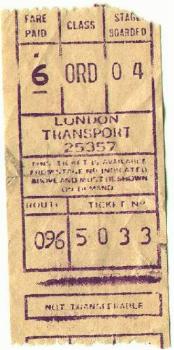
Gibson Ticket courtesy of John King
Appendix 1 - Amersham &
District Routes Taken Over by LPTB on 23 November 1933
Appendix 2 - Amersham Area London Country Routes
1968
Appendix 3 - Bus and Coach Allocation
Appendix 4 - Some London Country Maps and Fare
Charts
Garage Codes In & Around London
Pictures
of Local Buses in 1952
Amersham Bus Rally 2004
Amersham
& District Motorbus Society
Photo Credits / Copyright, Web-page links.
Ian Smith Ian's Bus Stop http://freespace.virgin.net/ian.smith/buses/index.htm
Ewen Pring Timebus/RLH http://www.timebus.co.uk/rlh
John King Transport History http://www.transporthistory.co.uk
Malcolm Crowe Oxford & Chiltern Bus Page http://www.oxford-chiltern-bus-page.co.uk
London Transport Museum http://www.ltmuseum.co.uk/
London Country Bus Services http://www.ampyx.org.uk/lcountry/
Bibliography
The London Country Bus by JS Wagstaff, Oakwood Press 1968
The Motor Bus in London Country by Kenneth Warren, Ian Allen 1984
ABC London Transport Buses, Coaches and Trolleybuses, Ian Allen 1955
London Buses Past and Present by John Reed, Capital Transport 1994
London Country in the 1970's by Steve Fennell, Ian Allen 2003
Greenline by A McCall, New Cavendish 1980
Timebus/RLH website Ewen Pring (see above)
London Country Bus Services website (Jonathan Wilkins) (see above)
London Buses in the 1960's by Ken Glazier, Capital Transport, 1998
Any additions, corrections, alterations, please email
the web master
Amersham Home Page
Although this page is not held on the amersham.org.uk domain, it is still
part of the www.amersham.org.uk site. This web site is Copyright
and operates a privacy
policy
please also see disclaimer